Frequently, I hear people try to antagonise Christians with the claim that Christianity supports slavery. Online debaters like Dean Withers or Parker constantly try to say that Christians should support slavery if they took the Bible literally, and modern thinkers like Alex O'Connor or Richard Dawkins try to use the claim that the Bible supports slavery to suggest we shouldn't believe in such an 'evil' God.
As Christians, we should be unashamed of the gospel and and stand firm on the Bible unapologetically. After all, everything in the Bible is God-breathed; each book, chapter, sentence, and word was inspired by Him. Therefore, it is important that we understand what the Bible says and can defend it unashamedly, because to be ashamed of the Bible is to be ashamed of the word from God.
Before we go through a verse-by-verse analysis of what the Old Testament says on slavery, I would like to get some points out of the way:
This writing is intentionally focusing only on the Old Testament. This is not because the New Testament doesn't mention slavery; it does plenty of times, but because of the nature of the writing. The Old Testament, particularly the laws, are God leading a nation in how to be a good society. The New Testament does not come to remove this or counter this, but to teach us further how we should live as individuals within any society. Jesus came not to abolish the law but to fulfil it. In our search for whether the Bible endorses slavery, we must therefore look to the Old Testament to find our answer.
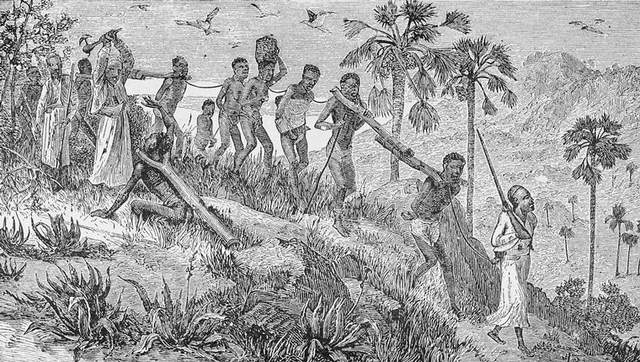
Secondly, when we, as Westerners in the 21st Century, think of slavery, we instantly think of the trans-Atlantic slave trade, as depicted in the image above. To fully understand what the Bible says, I would suggest you try to wipe that definition of slavery from your head, as that is not at all what slavery means in this context. The table below shows a comparison that can be made between the trans-Atlantic slave trade and slavery within Hebrew society:
Trans-Atlantic Slave Trade | Slavery within Hebrew Society |
|---|---|
Racial | Caused by poverty |
Fueled by kidnapping | Mutual contract between slave and owner |
Runaway slaves were killed or returned to their master | runaway slaves set free |
Beatings and rape were a normal thing for some slaves | Beatings and rape were not permitted and would be punished |
Involuntary | Volunatary |
Separation of family | Only voluntary separation |
No possessions | Possesions |
Verse by verse:
Exodus 21:16 (NIV):
"Anyone who kidnaps someone is to be put to death, whether the victim has been sold or is still in the kidnapper’s possession."
This clearly shows that someone could not be put into slavery through kidnapping. By extension, we know that to go into slavery, the slave must have consented. (Deut 24:7 also)
Exodus 21:26-27 (NIV):
"An owner who hits a male or female slave in the eye and destroys it must let the slave go free to compensate for the eye. 27 And an owner who knocks out the tooth of a male or female slave must let the slave go free to compensate for the tooth."
We can see that if the owner harms the slave, they must set the slave free as payback. This means the debts are set free, and the slave is free. In the Talmud (a collection of Jewish tradition and interpretation of law), this is seen as any permanent harm. But it can also be interpreted as any serious harm; similarly, "an eye for an eye, a tooth for a tooth" applies to all serious harm.
Exodus 21:20-21(NIV):
"Anyone who beats their male or female slave with a rod must be punished if the slave dies as a direct result, but they are not to be punished if the slave recovers after a day or two, since the slave is their property.”
This does not mean that if you beat them very near death and they survive, you go off scot-free. The word for punished in this is “נָקַם” (Naqam), which refers to the death penalty. The point being, just because you are the master, you don’t go off scot-free. So if you kill someone, whether they are a slave or not, you get the death penalty. In context, it just means the slave owner won’t be put to death if the slave survives, but will have the punishment from v26-27, as looked at above.
Exodus 21:2-6 (NIV):
"If you buy a Hebrew servant, he is to serve you for six years. But in the seventh year, he shall go free, without paying anything. If he comes alone, he is to go free alone; but if he has a wife when he comes, she is to go with him. If his master gives him a wife and she bears him sons or daughters, the woman and her children shall belong to her master, and only the man shall go free.
But if the servant declares, ‘I love my master and my wife and children and do not want to go free,’ then his master must take him before the judges. He shall take him to the door or the doorpost and pierce his ear with an awl. Then he will be his servant for life."
What does this mean?
6-year contract for a Hebrew servant
If the slave has a contracted wife, then she still has to finish her contract and her kids (not a slave forever based off other verses)
Unless he goes to the master (he himself can’t say this), saying verses 5-6. (Protecting from it being involuntary)
Deuteronomy 23:15-16 (NIV):
"If a slave has taken refuge with you, do not hand them over to their master. Let them live among you wherever they like and in whatever town they choose. Do not oppress them."
Unlike any other form of known slavery, if the slave runs away, they must be helped and assisted. Other people in Israel were required to help an escaping slave.
Leviticus 25:39-46 (NIV):
"‘If any of your fellow Israelites become poor and sell themselves to you, do not make them work as slaves. They are to be treated as hired workers or temporary residents among you; they are to work for you until the Year of Jubilee. Then they and their children are to be released, and they will go back to their own clans and to the property of their ancestors. Because the Israelites are my servants, whom I brought out of Egypt, they must not be sold as slaves. Do not rule over them ruthlessly, but fear your God.
“‘Your male and female slaves are to come from the nations around you; from them you may buy slaves. You may also buy some of the temporary residents living among you and members of their clans born in your country, and they will become your property. You can bequeath them to your children as inherited property and can make them slaves for life, but you must not rule over your fellow Israelites ruthlessly."
This is talking about the year of Jubilee. The year of Jubilee related to the promised land set for Israel and applied only to the Israelites. This meant that the Hebrew slave they must be set free on the year of Jubilee. But this does not mean that without the Jubilee they are never set free. Because when you combine this with the contracts and runaway laws seen earlier, there were still other clear limits.
Leviticus 19:33-34 (NIV):
"When a foreigner resides among you in your land, do not mistreat them. The foreigner residing among you must be treated as your native-born. Love them as yourself, for you were foreigners in Egypt. I am the Lord your God."
This applies both to slaves and to the free, and the same law for both Hebrews and foreigners because that is how the law worked. (see Exodus 12:49, Leviticus 24:22, Numbers 15:15–16). So the slaves who are also foreigners should not be mistreated but loved.
1 Chronicles 2:34-36 (NIV):
"Sheshan had no sons—only daughters.
He had an Egyptian servant named Jarha. Sheshan gave his daughter in marriage to his servant Jarha, and she bore him Attai.
Attai was the father of Nathan,
Nathan the father of Zabad,"
In this verse, we see that Sheshan treats his foreign slave so well as to let him inherit the land with his daughter. This shows how the Hebrew laws would actually look in practice: caring for and loving the slave.
Further notes:
It is worth noting that just because slavery was permitted within Hebrew society, it does not mean it was at all ideal or endorsed by God. We can see this through the example of divorce.
When Jesus is asked about why Moses commanded that a man give his wife a certificate of divorce and send her away, he replies that it was only allowed due to our "hardness of heart." This means that some laws enabled within the Old Testament only existed because we are in a fallen world, and it is the best way to run a society within that fallen world. So one could argue that slavery is not the ideal, but due to sin and poverty - which only exists due to us living in a fallen world - God allowed for slavery to exist in Hebrew Society.
Conclusion :
A different article could go through the involvement of Christians within the abolition movements, or what the New Testament says about slaves in societies where they aren't treated as well, or work in the same way as it did in God's setup for Hebrew society. But this article stuck to what God had set before us in how a nation should be run. And from it we can see his love and mercy and good moral code for the slave and the free.
Slavery within the code of conduct seen in Hebrew Law is far different to any form of slavery we would think of. Kidnapping, rape, beating, and killing are punished, but the slave voluntarily gave himself into slavery and must be treated well.
So, to answer the question, "Does the Old Testament Permit Slavery?" Yes, the Old Testament does permit 'slavery', but not a form of slavery, enabled to help the poor and those in debt earn money, have a place to live, and be fed. Ultimately, the slavery was formed out of love for those most in need.
An interesting video that goes into further detail on slavery within the entire bible can be seen below by Mike Winger. I highly recommend it!
Get new articles by email.